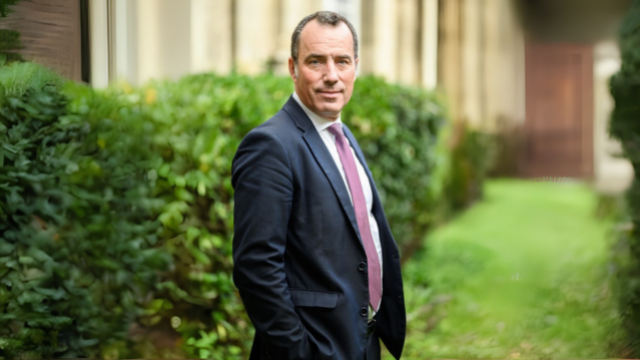
Bernard Charlès: A graduate driving the industrial revolution

Known worldwide for his visionary leadership and pioneering mindset, Bernard Charlès (Class of 1979, Mechanical Engineering) has built an extraordinary forty-year career at Dassault Systèmes, transforming the company into a global leader in industrial software.
"People don't always know what mechanical engineering is," Bernard Charlès begins. "Yet it is fundamental. When you formulate the equations that allow a satellite to land on the Moon, you're doing mechanics."
He recalls his years at ENS Paris-Saclay with great enthusiasm.
"Discovering mechanics through powerful theoretical frameworks, outstanding teaching, and hands-on laboratory work was an absolute delight."
Several professors left a lasting impression on him, including Pierre Bourdet, Pierre Padilla and André Clément.
"They demanded absolute clarity and precision of language. In the age of artificial intelligence, that skill is more critical than ever. The greatest challenge for engineers is to express complex problems in simple terms. In that respect, ENS Paris-Saclay is truly unique."
He also appreciated the School's strong experimental culture, which he describes as "an American-style approach that many engineering schools lack." He fondly remembers spending Saturdays in the workshops connecting machine tools to computers.
"We enjoyed it so much that it never felt like work."
An Admission Interview Conducted by a Future Nobel Laureate
Alongside academic excellence, Bernard Charlès displayed boundless curiosity and remarkable intellectual agility.
"I used to systematically reconstruct every lecture in my own way. My professors still remember that."
His classmates frequently borrowed his notes, carefully structured to reflect the impeccable logic of his teachers.
Years later, during a lunch with Alain Aspect, Charlès recognized the physicist who had examined him during his oral entrance examination to ENS Paris-Saclay. He asked whether he remembered him.
"You gave us a problem I didn't fully understand," Charlès recalled. "So I proposed three possible interpretations, each leading to a different answer. You asked me which one was correct, and I replied that I'd let you choose."
Aspect reportedly answered that he had never forgotten "the boldest candidate" he had ever interviewed.
Charlès still laughs about the episode.
"It's extraordinary to think that I entered ENS because of a situation that could easily have ended in complete failure. It reflects the way I think: always anticipating different scenarios and exploring every possible solution."
Setting Out to Change the World
After earning the French Agrégation and completing a PhD in Mechanical Engineering*, Bernard Charlès continued his research at the Institut Supérieur des Matériaux under Professor André Clément, whom he would later recruit to Dassault Systèmes.
At the time, he had one ambition: to create a start-up that would transform industrial processes through digital technology.
"In the early 1980s, computers were mainly used for administration or numerical calculations, producing endless streams of numbers. My friend Gérard Poisson and I had the audacious idea that computers should generate shapes, objects and motion. That vision came directly from the spirit of ENS Paris-Saclay. Watching a sequence of zeros and ones generate a machining process was extraordinary. We genuinely believed we were going to change the world."
In 1983, during his national service, he joined the French Defence Procurement Agency (DGA). Somewhat puzzled by this determined young graduate whose ambition was to create a company capable of representing the physical world through computers, the administration assigned him to a small start-up of about ten people: Dassault Systèmes, recently founded by Charles Edelstenne.
Initially hesitant, Charlès was persuaded by Catherine Fargeon, whom he describes as "an exceptional engineer."
"The company was producing software as a craft. I wanted to turn it into a true industry with clear ambitions."
At just 29, he became Chief Technical Officer, receiving carte blanche to redefine the company's strategy. His partnership with Charles Edelstenne was born—a collaboration that has now lasted more than four decades.
Revolutionising Global Industry on a 40-centimetre Screen
When Bernard Charlès became Chief Executive Officer in 1995, his own trajectory became inseparable from that of Dassault Systèmes.
"My career has been driven by a single obsession: using mathematics and technology to create virtual representations of the most complex objects ever designed by humankind."
He likes to describe himself as something of a spiritual heir to Leonardo da Vinci, combining engineering with history, culture and philosophy.
In the 1990s, at just 35 years old, he made the bold decision to design the Boeing 777 entirely in 3D, eliminating the need for any physical mock-up and enabling engineers around the world to collaborate in real time using a shared digital model.
"It was the largest industrial programme in the world: $15 billion in investment, 8,000 engineers across 60 countries. Designing a 350-ton aircraft on a 40-centimetre computer screen transformed manufacturing. The automotive industry soon followed."
When the aircraft rolled off the assembly line, it was fittingly named Working Together.
In 1996, together with Charles Edelstenne, Charlès convinced Serge Dassault to list the company on Nasdaq in order to accelerate its international expansion.
"I've always believed that you first need to succeed abroad before earning recognition at home."
Through the acquisition of more than 150 companies, Dassault Systèmes became a global powerhouse.
"Today, 95% of aircraft, 80% of cars and 60% of new therapies worldwide are designed using our software. No modern aircraft flies without it—except perhaps a few old relics," he says with a smile.
Building a New Narrative for Humanity
Approaching his seventieth birthday, Bernard Charlès now hopes to contribute to Europe's industrial renewal, which he describes as "a wonderful human adventure—a collective endeavour to create products that society truly needs."
Co-author, with Pierre Musso, of The Renaissance of Industry, he increasingly sees himself as a mentor, "a little like Robert De Niro in The Intern."
His advice to today's ENS Paris-Saclay students is simple: enjoy your studies.
"If you want to connect disciplines that rarely speak to one another, you've come to the right place. ENS Paris-Saclay is the only institution that brings together every scientific discipline, engineering and pedagogy without confining you to a teaching career. Observe how your professors teach. The greatest challenge for any leader is, in fact, to be an educator: listening carefully, articulating a vision, inspiring people and helping teams succeed. At heart, every leader is a teacher who also manages setbacks and reveals talent."
Today, his passion for modelling naturally resonates with the rise of artificial intelligence.
"Students often ask themselves what role they can play. I tell them that AI offers an unprecedented opportunity to create new narratives for humanity as we confront pressing challenges in healthcare, energy and housing. AI is simply a technology—a language serving human imagination, amplifying our intellectual capacity and our desire to create meaningful work."
He concludes with a broader reflection:
"Tomorrow's achievements will emerge from the co-creation and cooperation between humans and intelligent machines. Human beings must remain at the centre: intuition and the heart should continue to guide both the hand and the mind."
Championing Gender Equality
Bernard Charlès has also been a pioneer in a less widely known area: gender equality.
"Gender diversity is both self-evident and essential. Women bring different perspectives, different management styles and tremendous rigour."
As the father of four daughters and one son, he has translated this conviction into concrete action at Dassault Systèmes. Today, women make up half of the company's Executive Committee, while Florence Verzelen leads Global Engineering.
"To break the glass ceiling and overcome self-censorship, I introduced practical measures: guaranteed salary increases following maternity leave, absolute job protection, and an on-site childcare centre. Whatever people may say, genuine equality cannot exist without the right infrastructure. If something happens during the day, mothers simply have to cross the street to be with their baby."
This commitment also inspired the launch of the O'gur application in 2025. Designed as an interactive questionnaire, it aims to encourage young women to pursue careers in technology.
"I would love more young women to realise that they have an essential role to play in creating the products of the future, at the intersection of engineering, science and technology."
Doctoral thesis completed at the Institut Supérieur des Matériaux.

Comments0
Please log in to see or add a comment
Suggested Articles