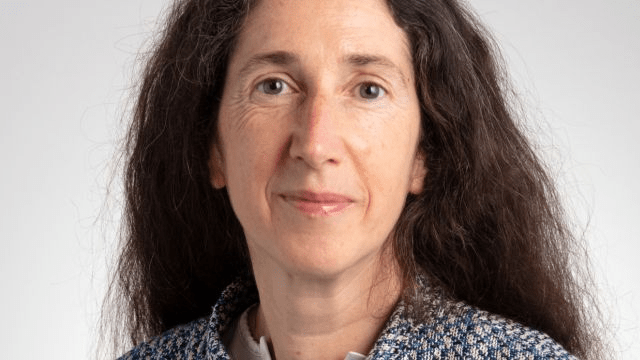
The entry of Anne-Isabelle Etienvre to the ENS Paris-Saclay in 1998 marks the beginning of her brilliant career, which corresponds in every respect, according to her, to “the DNA of the School: the alliance of research and teaching, the coupling with the university make it an absolutely unique institution,” she states.
“The size of the classes, too, allows for a human dimension and a very strong team spirit.”
She passes her agrégation in physical sciences in 1999, then follows with a Master 2 and a doctorate in particle physics at the Laboratory of the Two Infinities Irène Joliot-Curie (IJCLab) in Orsay, as a normalien scholarship holder and teaching assistant.
She is recruited by the CEA, at the Paris-Saclay center, immediately after obtaining her doctorate.
From research to industry
“In the CEA, there is a singular role: that of being at the service both of academic research and of French industry,” explains Anne-Isabelle Etienvre. The roadmap given by the State to the normalienne begins with the revival of nuclear energy in France, a major challenge. “From the extension of the existing plants to the closing of the fuel cycle, the CEA reconnects with its historical activity.”
At the same time, the organization continues research on decarbonized energies and mobilizes in the digital field, with a significant effort in microelectronics. “The goal is to have component lines for European industrial needs in a very tense context of international competition. The imminent hosting of one of the two European ‘exascale’ machines in Essonne is another illustration of the current challenges.
The CEA is also engaging in native AI as a science for its use in research, and in generative AI for its own fields.
Concerning the field of health, the CEA’s action focuses on ‘very technological areas of strength,’ inherited from its history in nuclear medicine: imaging — illustrated by the Iseult MRI, ‘the most powerful in the world’ — diagnosis, and digital health for oncology or neurological diseases.
‘The idea is to go from research all the way to the industrial sector by coupling with the clinical world, an objective materialized by a framework agreement with the AP-HP,’ affirms Anne-Isabelle Etienvre.
Finally, ‘it is essential to maintain excellent fundamental research concentrated on our core disciplines, useful for the CEA’s cross-disciplinary programs.’
The place of women in science
Evolving in a rather masculine environment, Anne-Isabelle Etienvre confides that this has never been a hindrance. “Physics, like engineering, remains not very feminine,” she concedes. “But I had the chance to be surrounded by people who encouraged me very early on. That said, when I took my position at the CEA, I received messages from women of all generations and all backgrounds that made me realize my appointment was a signal for them: that of moving forward.”
The normalienne regrets this form of self-censorship among young girls that prevents them from moving toward science — a phenomenon that, according to her, begins as early as primary school. “I think that today we need all talents! Beyond their intrinsic skills, women bring a complementary sensitivity that is necessary to meet the major challenges of our society.” The world of research must take responsibility and devote time to it. “For example, by giving young people the desire to come and try our professions as researchers, engineers, or technicians.” On this subject, she finds it “wonderful” to see ENS Paris-Saclay fully embracing this mission with all generations. “By conveying an image of academic excellence, the School plays an important role in inspiring scientific vocations.”
Giving birth to the gems that will make tomorrow’s breakthroughs
Born in Saclay 80 years ago, the CEA also contributes to the excellence of its ecosystem, which combines engineering schools, universities, research organizations, and industrial partners, while fostering bridges between very diverse profiles.
Proudly recalling that the 2025 Nobel Prize in Physics was awarded to a researcher trained at the CEA, Michel Devoret, Anne-Isabelle Etienvre underlines the importance, both for ENS Paris-Saclay and for her organization, of “mentorship” between the older and the newer generations, “indispensable for giving birth to the gems that will make the breakthroughs of tomorrow.”
“From this point of view, we do not lack beautiful projects to offer to the normaliens, who have their full place at the CEA.”
Science, this common good
More broadly, Anne-Isabelle insists on the necessary collective vigilance in the face of a scientific voice that is constantly being questioned. In this context, having appointed a scientist at the head of the CEA makes perfect sense. “It is the duty of researchers to explain the scientific process: its successes and its failures, everything that makes up the life of a researcher. During my hearings for the position of General Administrator of the CEA, I always affirmed that this work of demystification with citizens was important to me. I have at heart to make them actors in our research.”
An approach that involves continuous work with the media and through “Science and Society” programs, in particular.
“Science is a common good that belongs to everyone,” she concludes.

Comments0
Please log in to see or add a comment
Suggested Articles