Olivier Vigna, a Normalien in the Service of France’s Economic Attractiveness
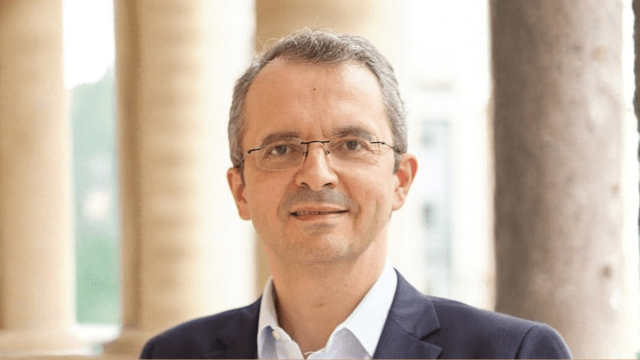
Olivier Vigna (class of 1991, Economic and Social Sciences) is the Secretary General of Paris Europlace, a strategic position in his brilliant career path shaped in the economic sector, at the crossroads between public financial institutions and the private sector.
Olivier Vigna joined the Department of Economic and Social Sciences at ENS Paris-Saclay in 1991 with the aim of simultaneously pursuing a degree at Sciences Po. This institutional flexibility is an opportunity he still praises today. “I am very grateful to Michel Bitard, then head of the department, who agreed that I could juggle between the campuses of Sciences Po and Cachan,” he confides. According to Olivier Vigna, this trust placed in students’ projects is characteristic of the “ENS hallmark.” He retains from his years at the École and at Sciences Po the memory of great intellectual stimulation. While deepening his knowledge of economics, his preferred discipline discovered in preparatory classes, he opened himself to other disciplines such as sociology, history, or political philosophy, and at the same time completed a master’s degree in sociology at Nanterre. This multidisciplinary background allows him, he says, to be today “comfortable in very different environments” and to adapt with agility to evolving professional contexts, whether public or private.
From One Shore to the Other
Upon graduating from ENS, Olivier Vigna completed his military service and then passed the competitive examination for the Banque de France, which he joined in 1996. There, he held several economist positions: at the Banking Commission, at the General Inspectorate, then at the Directorate of Studies, and finally at Financial Stability. In 2012, Olivier Vigna became Chief Economist of the Autorité des marchés financiers, overseeing risk analysis and market regulation, and in 2015 he was appointed Chief Economist of Agence France Trésor (at Bercy), the body in charge of managing the State’s debt, a highly strategic position. In 2020, a change of direction: Olivier moved to “the other side of the mirror,” joining HSBC Continental Europe as Chief Economist for France.
Olivier Vigna fully embraces having “crossed the Rubicons” to navigate between the public and private sectors, between economic regulation and financial markets. “I have never had any difficulty moving from one position to another, the previous one feeding the next,” he confides. He considers this mobility essential to a career and moreover encourages future normaliens to clarify their ambitions: do they seek the stability of a single employer or the richness of the unknown? For him, normaliens possess major assets to adapt to transitions. “From the moment one starts thinking about mobility, it means one wants it. And when one wants it, one finds the capacity for it,” affirms the CEO.
Twice in Olivier Vigna’s career, his capacities for reflection and adaptation were severely tested: during the 2009 financial crisis, when he was head of the economic activity forecasting department for the euro area at the Banque de France, and in 2020, during the COVID-19 pandemic. At that time, he was Chief Economist for France at HSBC Continental Europe. “How can one establish economic forecasts with no historical reference points? What did the lockdowns imply? For both crises, we had no possible comparison; it was complete novelty.”
Paris Europlace: Strengthening France’s Attractiveness
After having explored all facets of the economist’s profession, Olivier Vigna left the banking world, whose charms he had, in his words, “exhausted,” driven by the desire for a “new adventure.” Since 2026, he has held the position of Secretary General of Paris Europlace. This association brings together 600 companies and federations of all sizes, including many foreign entities. “France has gained credibility and the Paris financial center has developed considerably over the past ten years, driven by Brexit and by reforms carried out by the French authorities,” he analyzes. For the Secretary General, the mission of Paris Europlace is twofold. First, it involves strengthening France’s attractiveness in order to encourage major economic players to locate there and create jobs. “We do not specifically defend French players, but players established in France,” he specifies. Second, the association works on adapting their regulatory environment. “It is not enough for them to settle; Paris Europlace supports them in building the best possible legal framework in the face of competition from London, Frankfurt, Milan, or New York,” he insists. For Olivier Vigna, it is therefore essential that the authorities listen to representative organizations.
Concretely, this dialogue takes place through technical working groups and the organization of conferences bringing together industry and public authorities. Paris Europlace also relies on two branches, the Institute for Sustainable Finance and Finance Innovation, which together employ around thirty staff members. In a daily life where “the unexpected is the rule—one day I meet a company CEO, the next day the office of the Minister of the Economy,” this intense advocacy work has become the core of Olivier Vigna’s profession. It has moreover borne fruit: the Secretary General notably welcomes the fact that the law of 13 June 2024 on financial attractiveness directly incorporates, in its Title II, recommendations stemming from a Paris Europlace report.
Education and Excellence
Olivier Vigna is attentive to education and knowledge transmission. In addition to the courses he still teaches at Sciences Po, he has also taken part in educational initiatives aimed at school audiences, whose objective was “to explain what economics is for and what a financial center is.” For him, the international recognition of France’s grandes écoles is an asset that must be actively maintained. But since excellence is an evolving notion, it cannot be based on yesterday’s criteria. To remain high-performing and meet current market expectations, openness to the world is essential. “A school of excellence is a school in motion, capable of opening itself to new subjects,” he concludes.

Comments0
Please log in to see or add a comment
Suggested Articles